The question comes up more than any other, usually a little hesitantly: can I come on my own?
You can — and here’s the part that surprises people: most do. On a well-run retreat, the solo traveller isn’t the exception to plan around. They’re the majority. If the idea of arriving alone makes you uneasy, that feeling is worth taking seriously, so let’s walk through exactly what coming on your own actually looks like, from the worry to the daily reality.
You will not be the odd one out
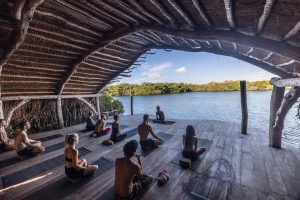
The fear is specific: that you’ll show up to find a room full of couples and old friends, and spend a week as the spare part. It’s a reasonable thing to imagine and almost never what happens. Retreats draw solo travellers precisely because they’re built for it — there’s structure, a shared purpose, and a group that forms quickly because everyone is in the same position. The people who come with a friend are usually the ones who feel slightly outside the group that forms, not the other way around.
What dissolves the awkwardness is the structure itself. You’re not dropped into a room and told to mingle. There’s a shape to the day — practice in the morning, meals at set times, something in the afternoon — and shared rhythm does the social work for you. By the second dinner, the table sorts itself out.
How much togetherness is up to you
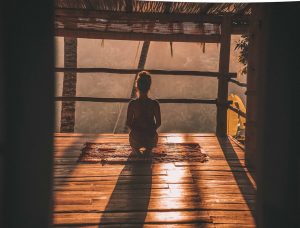
A good retreat is designed around a simple principle: together when it helps, alone when it doesn’t. The practices and the meals are communal. The hours in between are yours. Nobody is keeping track of whether you join the optional afternoon walk or stay back with a book, and the better the retreat, the more deliberately that solitude is protected. Coming alone often means you get more of this, not less — you can follow your own thread through the week without negotiating it with anyone.
If you’re someone who recharges by being quiet, this is genuinely one of the best ways to travel. You get the warmth of a group at the edges of the day and uninterrupted space in the middle of it.
The practical questions solo travellers ask
Accommodation. You’ll usually have a choice. Many retreats offer a private room as standard or for a supplement, and some offer a shared twin — which, if you’re open to it, is a low-stakes way to meet someone and trim the cost. There’s no expectation either way; you pick what lets you rest.
Arrivals and transfers. This is where coming alone can feel most exposed — landing in an unfamiliar country by yourself. A retreat worth its price handles the airport-to-door part for you, coordinating arrival times so you’re met rather than left to find your own way. Worth confirming before you book.
The daily rhythm. Knowing the shape of a day takes a lot of the unknown out of it. We’ve written that up separately in what actually happens on a retreat day — read it if the open-endedness is the part that worries you.
Do I need experience? No. Nervous-system-first practice meets you where you are, whether you’re seasoned or simply curious. Coming alone and new to yoga is one of the most common combinations there is.
Packing. One less thing to overthink — see what to pack for a warm-weather yoga retreat.
Why solo suits what we’re building
Solipse retreats are about a reset — settling an overworked nervous system, and being properly present for a few rare minutes of totality. That’s an inward thing. People often find it lands more cleanly when they’ve come for themselves, without managing a companion’s experience alongside their own. Arriving alone isn’t the compromise. For a lot of our guests, it’s the point.
If you’d like a softer first step than a full retreat, our December gathering is a shorter, gentler way in.
Thinking about coming on your own? Leave your email and we’ll keep you posted as dates and places firm up — no commitment, just the journey as it unfolds. Keep me in the loop ↗