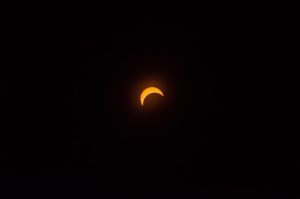
Most of us have seen the sun with a bite taken out of it. You hold up a pair of cardboard glasses, the moon slides across a corner of the disc, the afternoon dims by a notch, and an hour later it’s over. That’s a partial eclipse — and it’s a genuinely different event from a total one. A total solar eclipse isn’t a brighter version of the same thing. It’s a threshold the partial phase only walks you up to.
Here’s what actually happens when the moon covers the sun completely.
The long approach
Totality doesn’t arrive suddenly. For more than an hour beforehand, the moon creeps across the sun and almost nothing seems to change — daylight is so abundant that even a sun 80% covered still lights the world convincingly. This is the part people underestimate. You spend the lead-up thinking is this it?
Then, in the last ten or fifteen minutes, the world starts to behave strangely. The light goes thin and metallic, as if someone has turned down a dimmer you didn’t know existed. Shadows sharpen to a knife-edge. The temperature drops — often by several degrees. Look at the ground under a leafy tree and you’ll see hundreds of tiny crescents: each gap between the leaves is acting as a pinhole camera, projecting the shrinking sun. Birds quiet down. The horizon takes on the colour of a sunset in every direction at once.
The last seconds, and then totality
In the final moments before totality, the last sliver of sun breaks into a string of bright beads — sunlight pouring through the valleys on the edge of the moon. This is the diamond ring: one final blaze of light on a darkening ring. Then it goes.
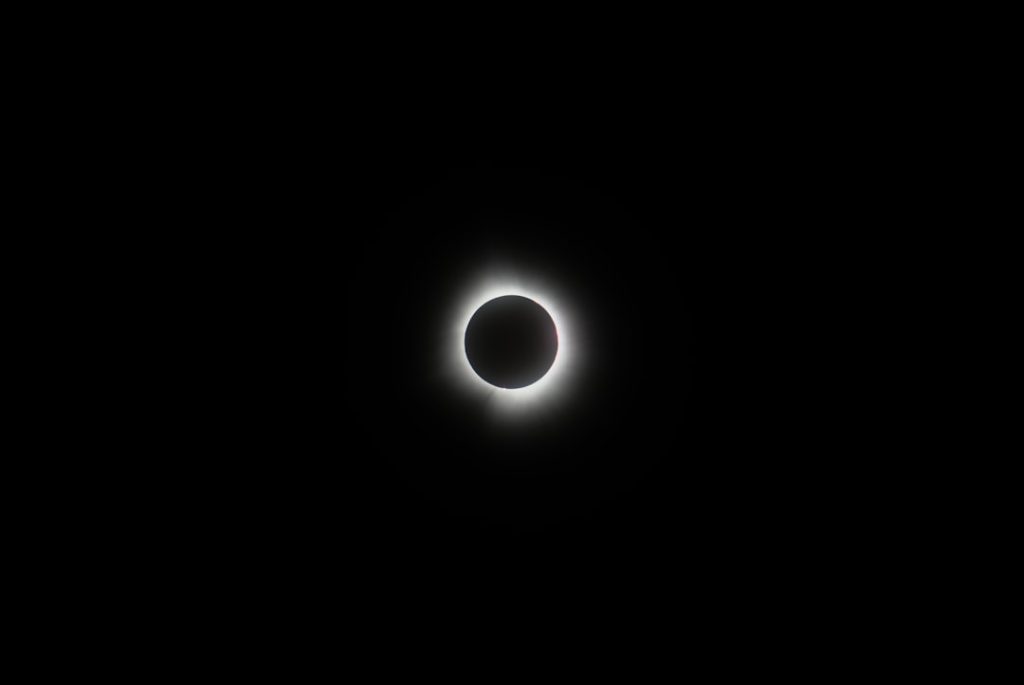
For the length of totality, you can take the glasses off — and you should, because this is the only phase that’s safe to watch with the naked eye, and the only one worth travelling for. Where the sun was, there is now a black disc ringed by the corona: the sun’s outer atmosphere, a pale silver crown streaming into space, invisible at any other time. The sky deepens to twilight. Planets and bright stars come out. The air is suddenly cold and still.
And then the moon keeps moving, a second diamond ring flares on the opposite edge, the glasses go back on, and the whole sequence reverses.
Why it lands in the body, not just the eyes
People expect an eclipse to be a visual event. What surprises them is that it’s a physical one. The sudden cold, the wrong-time-of-day darkness, the silence — your body registers all of it before your mind has caught up, and the response is often involuntary: a gasp, tears, the hair standing up on your arms. This is a large part of why we build retreats around totality rather than just viewing it. A regulated, rested nervous system is far more available to a few minutes like that than a frazzled one stumbling off a tour bus. (More on that in why rest is part of the practice.)
What this looks like in 2027
The next great one is the total solar eclipse of 2 August 2027. Its path of totality crosses southern Spain and sweeps across North Africa — and it is unusually long. Along the centre line, totality lasts up to roughly six minutes, with the longest accessible stretch near Luxor in Egypt. For comparison, most eclipses give you two or three minutes; six is extraordinary, and a duration like it won’t return to accessible land for generations.
That length is why we’re building around this particular eclipse. You can read the verified timings, country by country, on the 2027 eclipse page, and explore the four places on the path we’re choosing between on the destinations page.
One safety note worth repeating: during every partial phase — which is everything except totality itself — you must use proper eclipse glasses or a certified solar filter. Only when the sun is completely covered is it safe to look directly. Sunglasses are not enough.
We haven’t fixed where we’ll host the 2027 retreat yet — there are four places on the path, each with a real trade-off, and we’re letting the people who want to come help decide. See all four and cast your vote ↗
Image: Photo by Adriel Sand on Unsplash.