
- 6 min 22 sec totality
- 2 Aug 2027
- Near-certain clear skies
- e-Visa / visa on arrival
The eclipse here
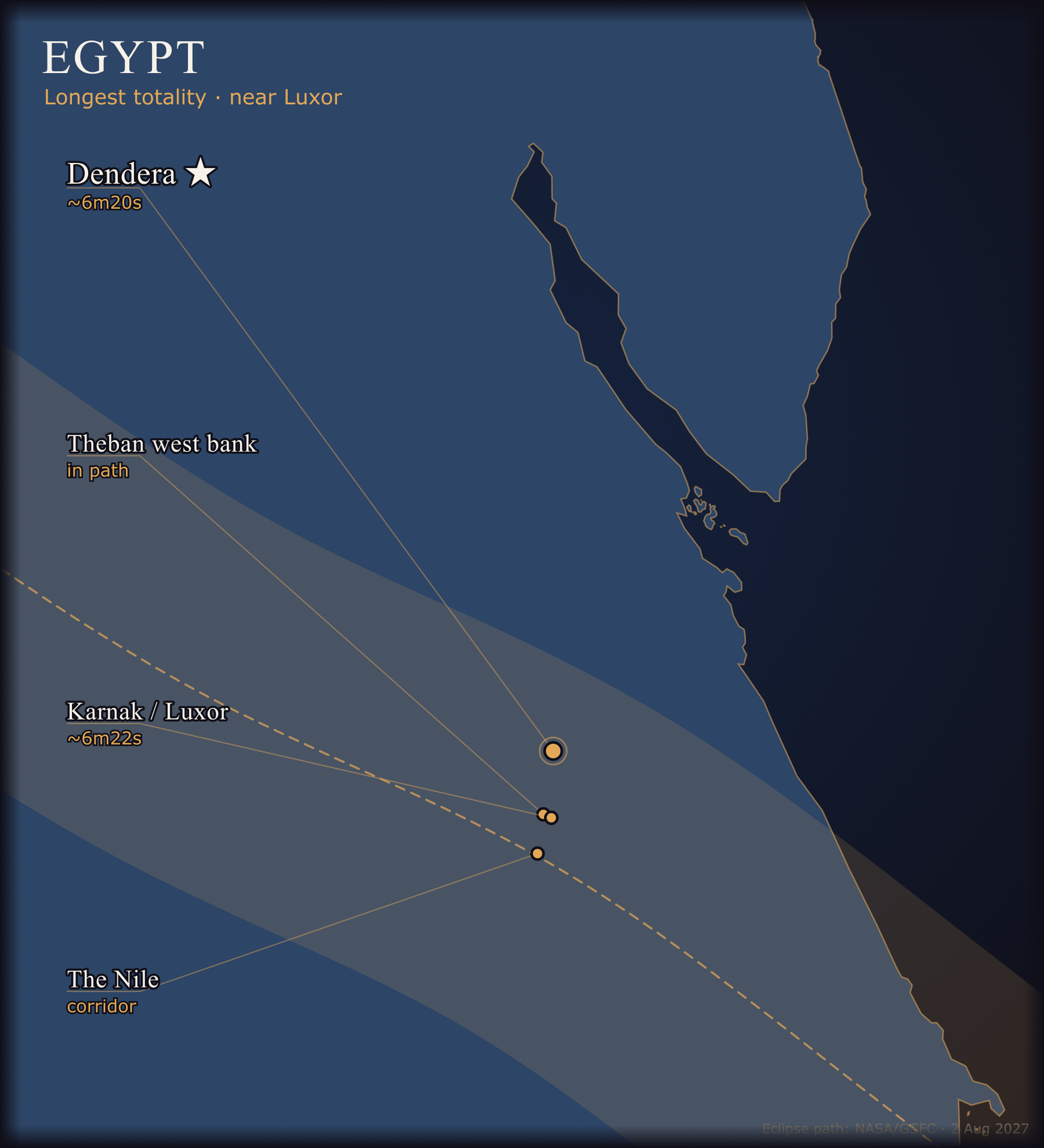
The 2027 path passes over Upper Egypt, with peak totality near Luxor — exactly 6 minutes 22 seconds at maximum. One of the most cloud-free stretches of the entire path: forecasters rate Luxor and the Upper Nile valley as near-certain for clear skies.
The longest totality, over the oldest river
Upper Egypt sits beneath the maximum of the whole eclipse — about six minutes and twenty-two seconds over Luxor and the Nile, the longest spell of totality on easily reachable land until 2114. Four places gather around it.
In the path · ~6m 20s
Dendera & the temple of Hathor
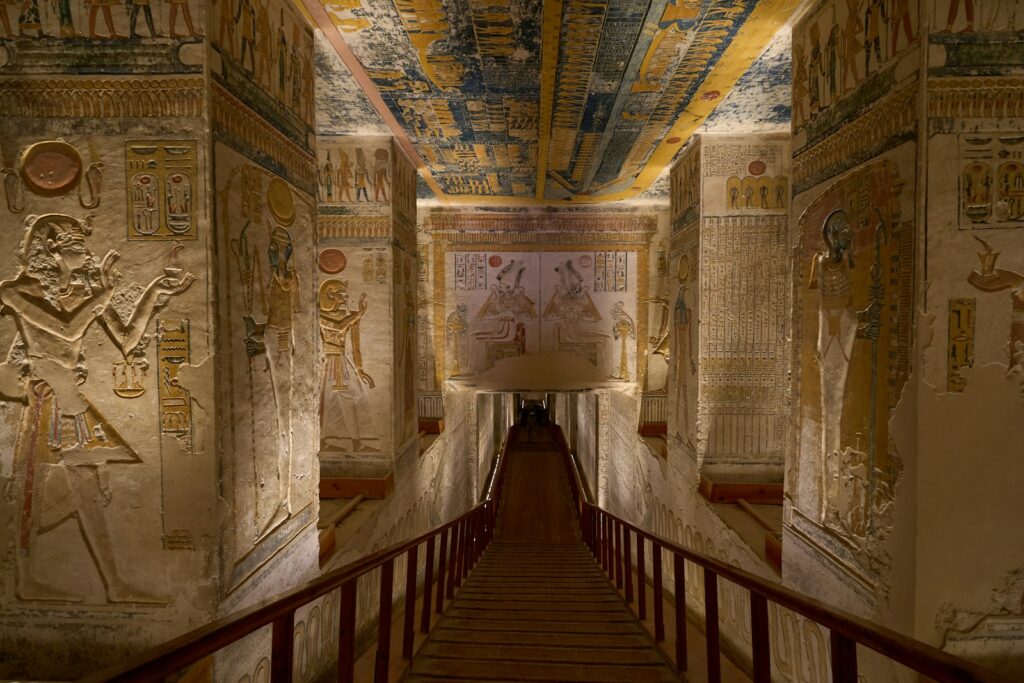
An hour north of Luxor, near Qena and squarely under the longest totality, stands one of the best-preserved temples in Egypt — sacred to Hathor, goddess of the sky. Its ceiling carries the famous Dendera zodiac, an ancient map of the heavens cut in stone. A celestial temple beneath a six-minute eclipse, and far quieter than the crowds at Karnak.
Across the river
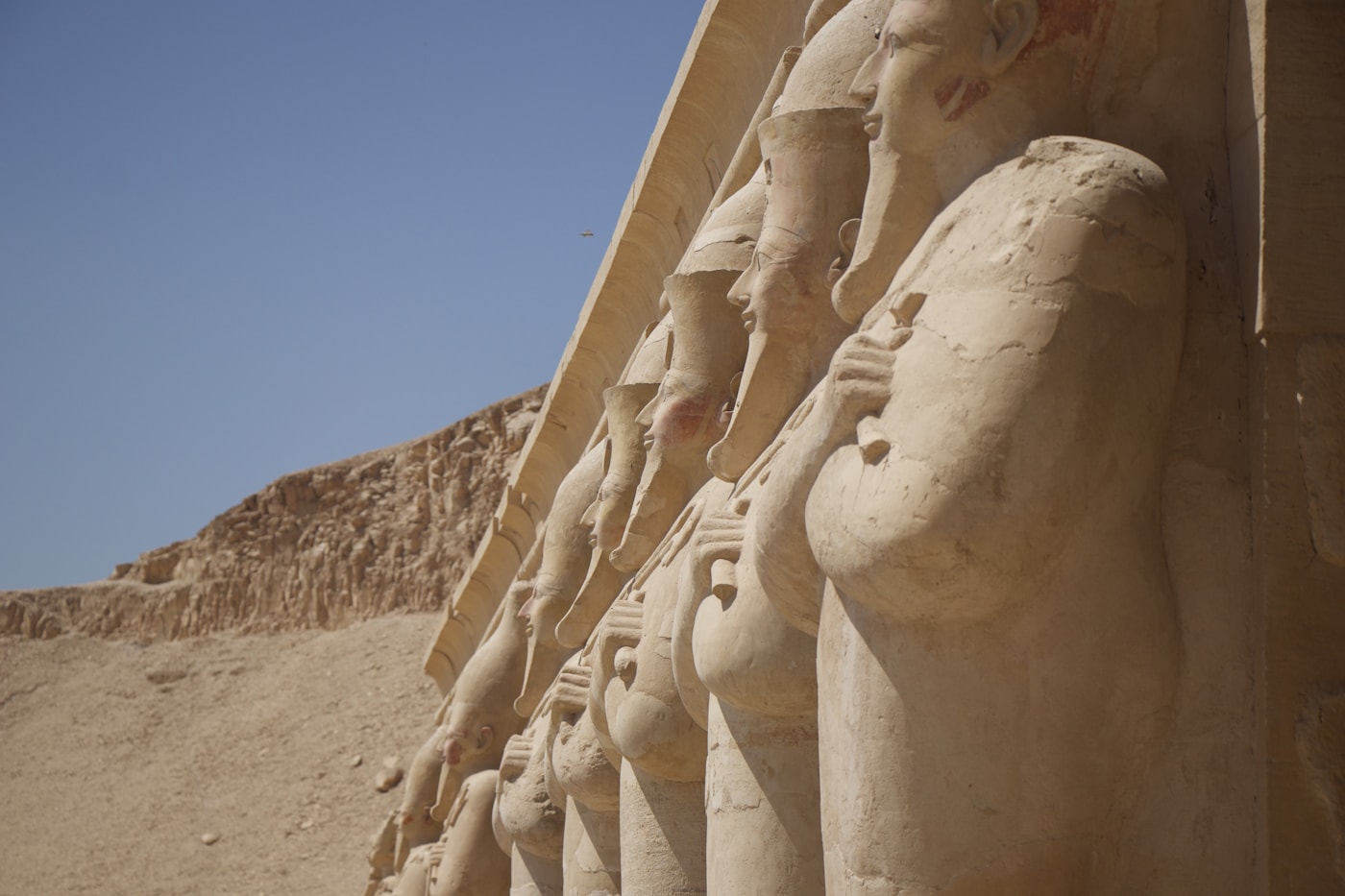
The Theban west bank
Where the green of the Nile gives way to the desert hills that hold the Valley of the Kings, the temple of Hatshepsut and the Colossi of Memnon. Dawn here — the temple statues catching first light, the river still — is one of the quietest, strangest mornings in travel.
The river itself
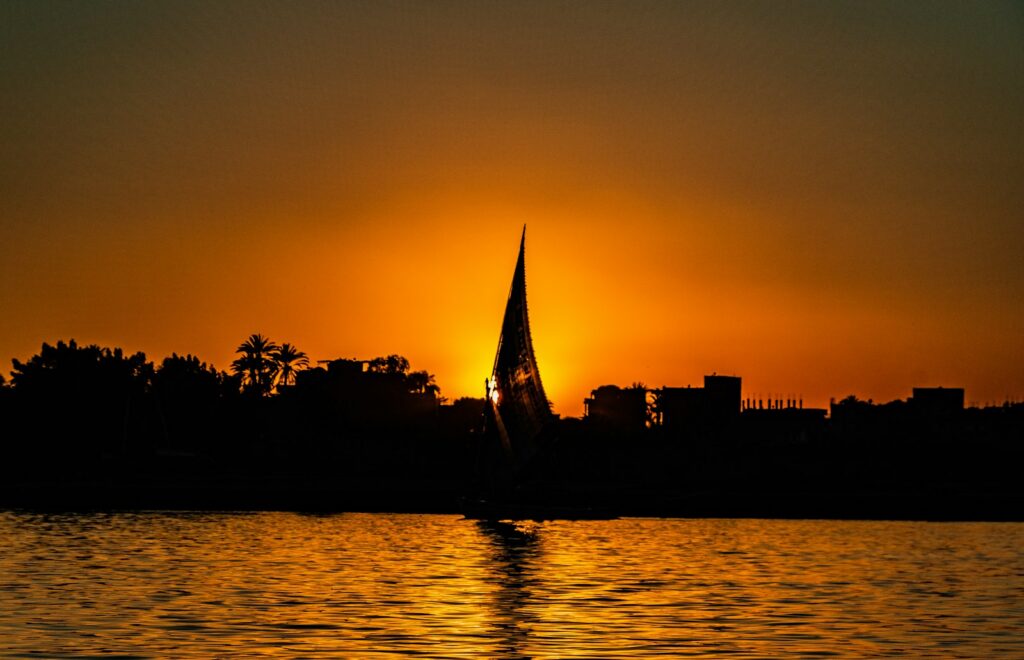
Dawn and dusk on the Nile
The connective tissue of the whole place: a felucca under a single sail, the bank slipping by, fishermen and egrets and the long light. The retreat’s slow centre — on the water, off the road, with nothing to do but watch the day turn.
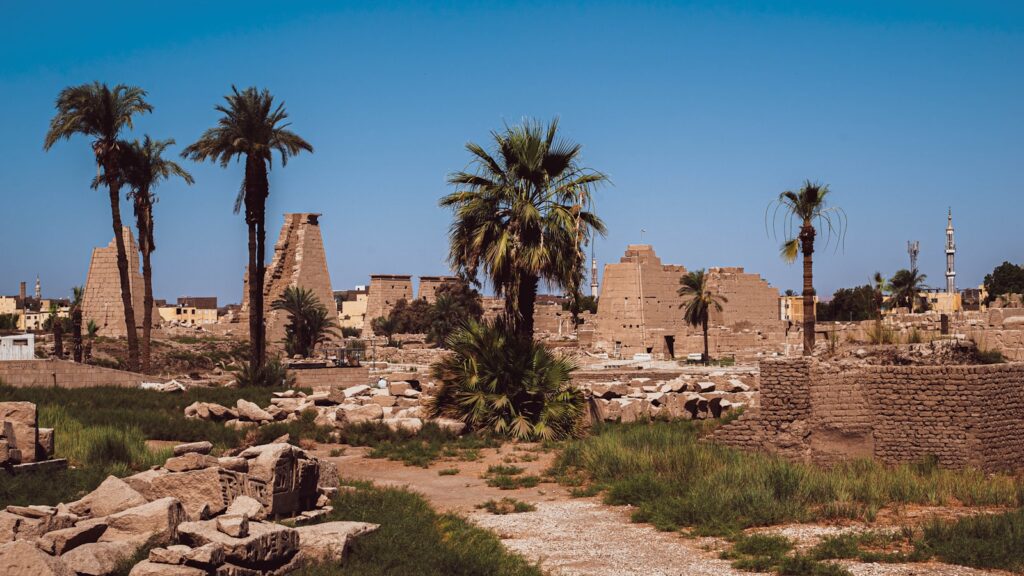
In the path · ~6m 22s
Karnak & the temples of Luxor
Luxor is the richest concentration of ancient monuments on Earth, and it sits almost exactly under the point of greatest eclipse. Karnak alone is a city of temples grown over two thousand years — avenues of rams, a forest of carved columns, the morning light coming in low and gold.
Knowing before you go
Getting there & remoteness
Luxor has its own international airport, and is an easy domestic hop or a Nile cruise from Cairo. The Nile valley is the spine — everything strings along it — so moving along the valley is simple by road, rail or river. It’s only out in the Western Desert beyond the valley that the genuine remoteness begins. This is the most exotic of the four candidates, and honestly the most demanding to deliver well: the heat, the crowds at the headline sites, and the logistics all ask more than Morocco or Spain.
Weather in August
Hot — 38–42 °C in the afternoon — but a dry desert heat, not humid, and the mornings and evenings are far kinder. There is essentially no rain, and Upper Egypt has some of the most reliable clear skies anywhere on the eclipse path: forecasters rate Luxor and the Nile valley as near-certain for a cloudless sky. We’d build the days around the cool hours.
Food
Generous and vegetable-forward: ful medames and ta’ameya (Egypt’s own falafel) for breakfast, koshari, warm aish baladi bread, grilled Nile and Red Sea fish, molokhia, sun-ripe dates and mangoes, and endless glasses of mint tea and deep-red karkadeh (hibiscus). Made for slow, shared meals.
Religion
Predominantly Sunni Islam, with an ancient and significant Coptic Christian minority. Faith is woven through daily life; the call to prayer marks the rhythm of the day and Friday is the holy day. Visitors are warmly received — modest dress is simply appreciated, never demanded.
Culture
A layering of Pharaonic, Coptic, Islamic and — in the south — Nubian threads. Upper Egypt is more traditional and unhurried than Cairo: tea-and-welcome hospitality, lively souqs, music, and a deep, living pride in a past that is everywhere underfoot.
History
Five thousand years of it, and Thebes — modern Luxor — was the heart of it for much of that time. Pharaonic temples and tombs, then Greco-Roman, Coptic and Islamic layers, all stacked along the same stretch of river. Luxor is often called the world’s greatest open-air museum, and it earns it.
Languages
Arabic (the Egyptian dialect) is official; English is widely spoken across tourism, with some French and German around the major sites. You’ll get by easily in English.
Money
The currency is the Egyptian pound (EGP). It’s a cash-first culture — withdraw from ATMs in the cities (carry some smaller notes), while hotels and larger restaurants take cards. Baksheesh (small tipping) is part of daily life, and gentle bargaining is normal in the markets. Prices are low by European standards.
Safety
The tourist regions — Luxor, Aswan, the Nile corridor — are heavily policed and generally safe for visitors; Egypt takes the security of its tourism seriously. The usual care applies with persistent vendors and touts, road-crossing and the August heat. Solo women can expect some attention; modest dress and a little confidence go a long way. Some remote desert and border regions carry official travel warnings, but the Nile-valley itinerary stays well clear of them.
Good to know
- Dress — modest at temples and in towns (shoulders and knees); relaxed at a private retreat.
- Alcohol — available in licensed hotels, restaurants and bars, not everywhere.
- Connectivity — strong 4G; a cheap local SIM or eSIM (Vodafone, Orange, WE) keeps you online.
- Health — drink bottled or filtered water only; no required vaccinations for most; travel insurance is essential.
- Heat & sun — August is intense; hat, water and shade are not optional.
- Time zone — GMT+2. Agree taxi and calèche fares before you set off.
- Respect — always ask before photographing people.
Entry & visas
This is where Egypt asks a little more than the others: most visitors need a visa. For tourism you have two easy routes — apply online for an e-Visa before you fly (about US$25, single entry, 30 days), or buy a visa on arrival at the major airports (about US$25, paid in cash). Your passport needs six months’ validity and a blank page. We’d guide guests through this well ahead of time. Always confirm on your own government’s page before booking:
| You’re from | Tourist entry | Official source |
|---|---|---|
| United Kingdom | e-Visa or visa on arrival (30 days) | gov.uk travel advice |
| United States | e-Visa or visa on arrival (30 days) | travel.state.gov |
| Canada | e-Visa or visa on arrival (30 days) | travel.gc.ca |
| Australia | e-Visa or visa on arrival (30 days) | smartraveller.gov.au |
| New Zealand | e-Visa or visa on arrival (30 days) | safetravel.govt.nz |
| EU / Schengen | e-Visa or visa on arrival (30 days) | Your national foreign-ministry travel advice |
Apply only through Egypt’s official e-Visa portal — visa2egypt.gov.eg — many lookalike sites charge inflated fees or are outright scams. Apply at least 7 days before travel; visa on arrival (cash US dollars) is available at major airports. This is a guide, not official advice — verify with the sources above before you book.
The honest trade-off
From the Journal
Victoria as a Solipse gathering place: summer light, coast and reset
Victoria is not the most exotic place Solipse could begin. That is part of its strength.
Tunisia on the path: Sahara, Sfax and a quieter route to totality
Tunisia sits on the 2027 eclipse path with a different kind of promise. It is less obvious than Egypt, less…
Totality: why the sky going dark changes the body’s sense of time
A total solar eclipse is often described as a visual event: the moon passes in front of the sun, daylight…