
- Up to 5 min 41 sec totality
- 2 Aug 2027
- Reliably clear skies
- Visa-free (most)
The eclipse here
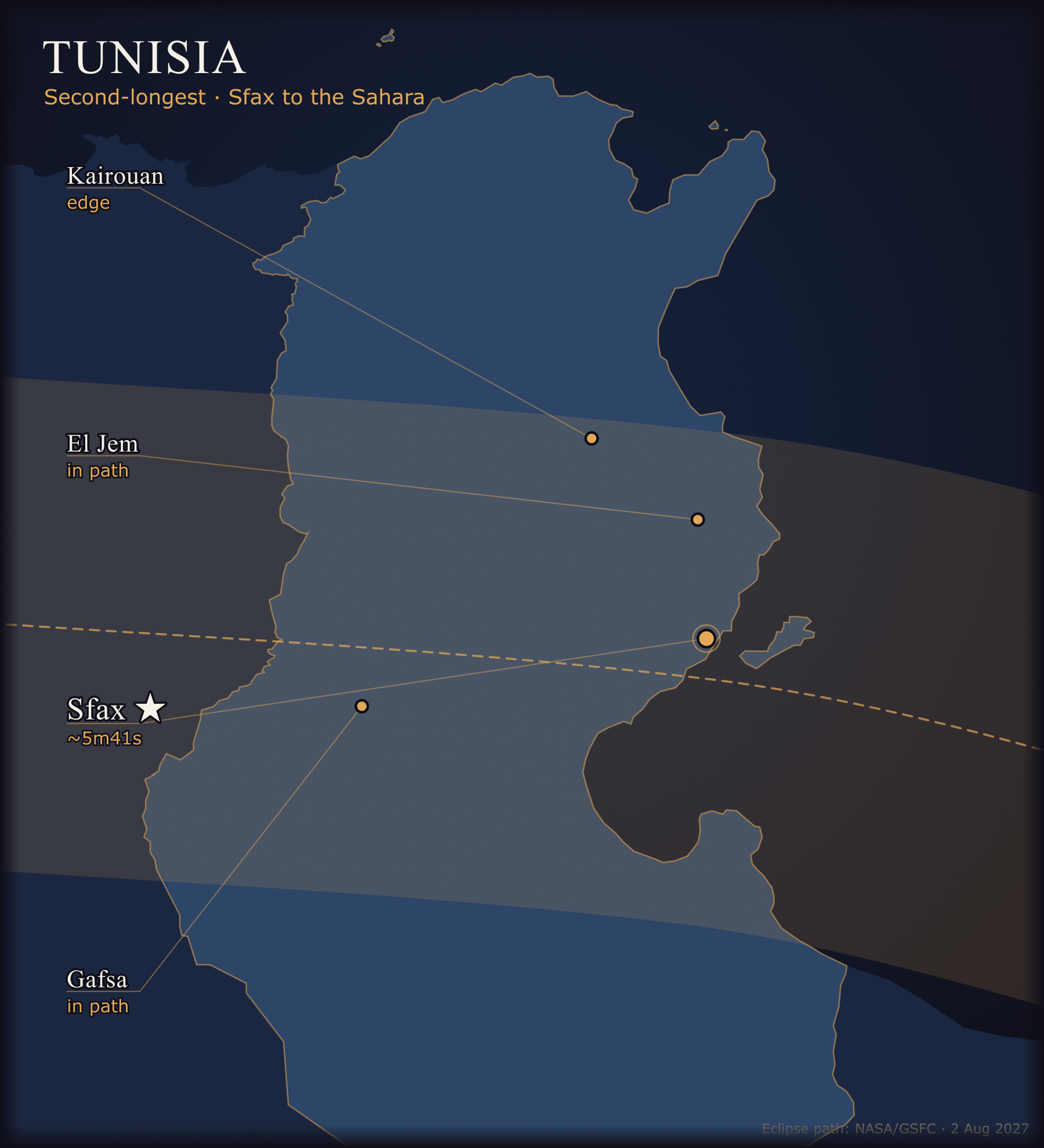
The 2027 path crosses the centre of Tunisia. Totality runs longest on the coast — about 5 minutes 41 seconds at Sfax — and over five minutes inland near Kasserine (5 min 28 sec). Second only to Egypt in the group, and with far smaller crowds.
Saharan, singular, and second only to Egypt
The path crosses the centre of Tunisia with some of its longest totality — over five and a half minutes on the coast at Sfax — through a country still largely off the tourist map. Four places along it.
In the path · ~5m 41s
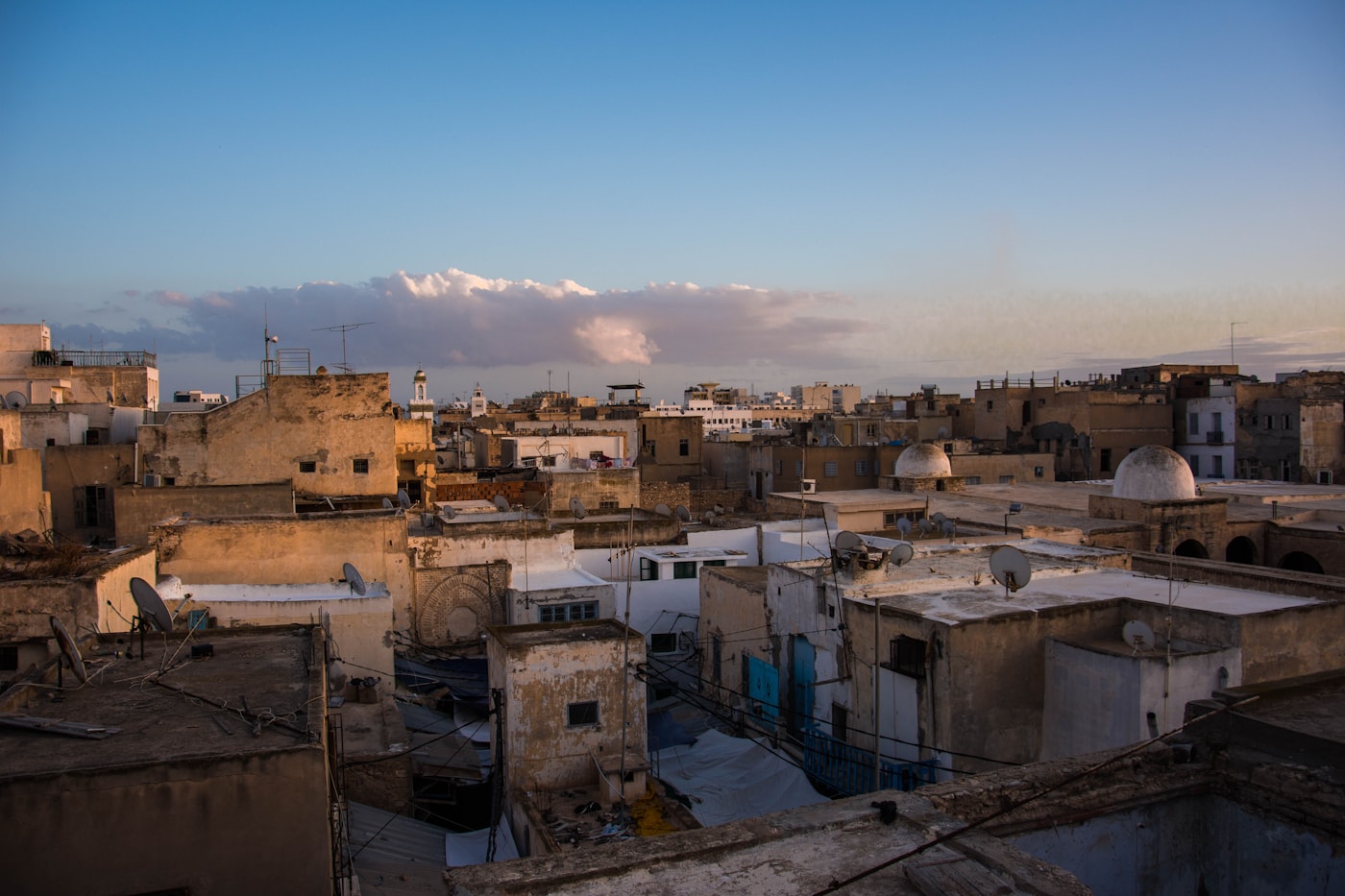
Sfax & the longest totality
Tunisia’s second city catches the longest darkness in the country — about five minutes forty — yet sees almost no tourists. Its walled medina is one of the most authentic in the Maghreb, working and unpolished, and the sleepy Kerkennah Islands lie just offshore.
UNESCO · Roman
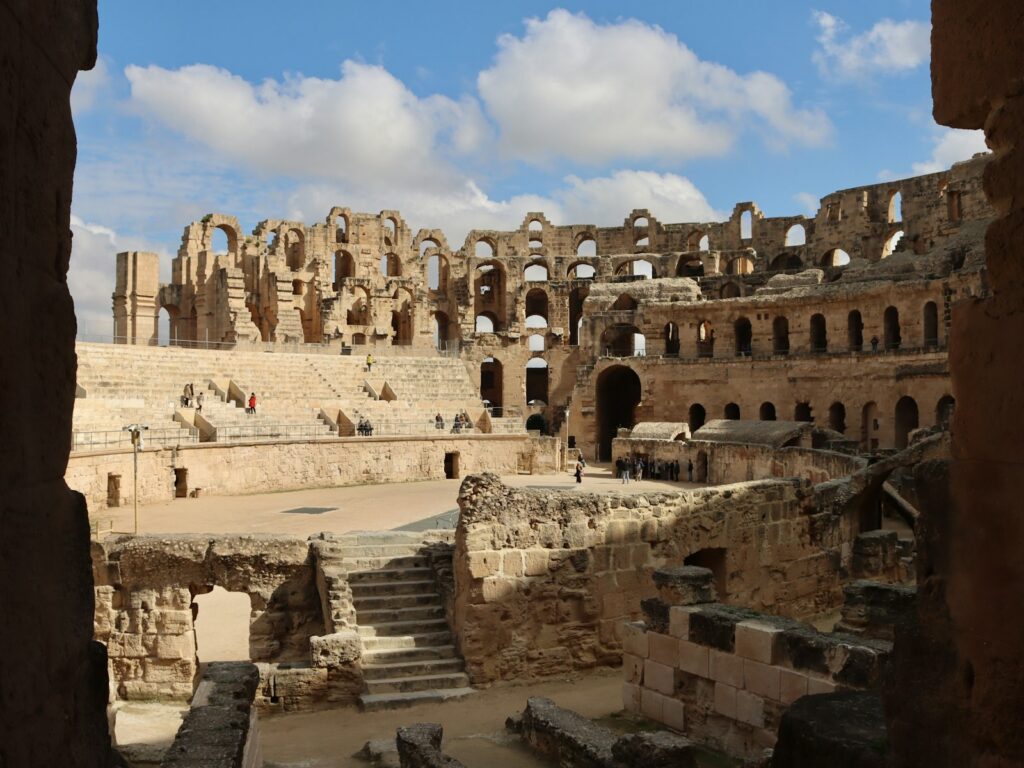
The amphitheatre at El Jem
One of the largest Roman amphitheatres ever built, rising whole and astonishing straight out of a small modern town in the Tunisian flatland — bigger and emptier than you expect, and squarely under the path.
A holy city · UNESCO
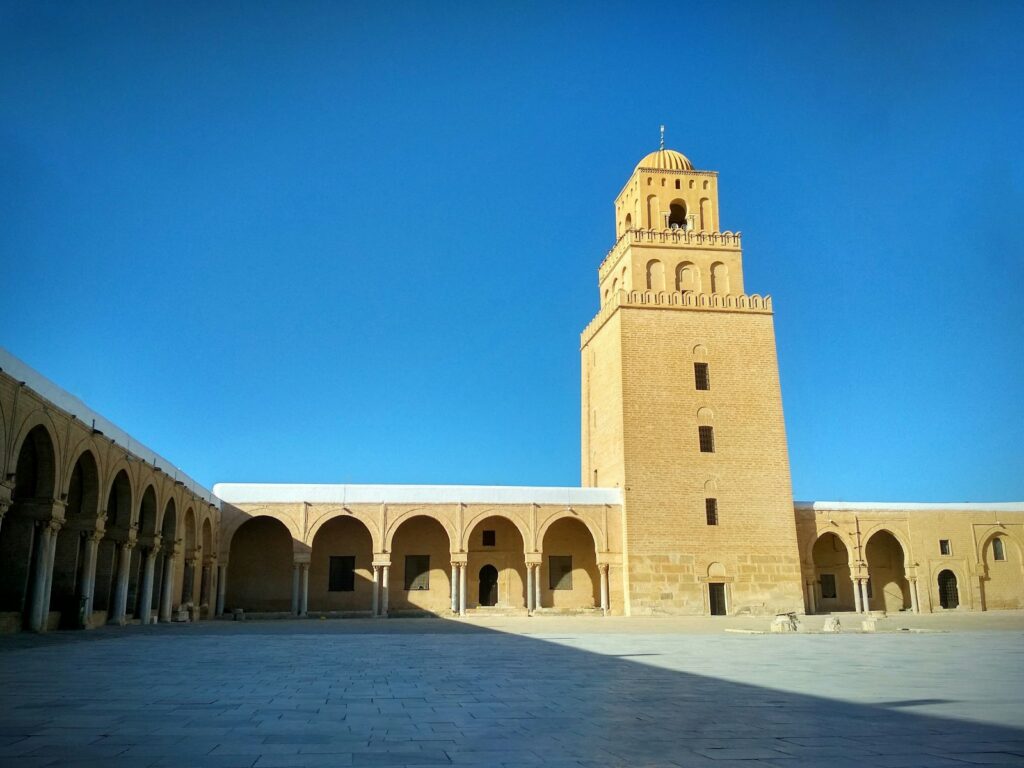
Kairouan
The oldest Arab-Muslim city in North Africa and one of Islam’s holiest, its Great Mosque a vast courtyard and a forest of ancient columns. It sits near the northern edge of the path — shorter totality, but an extraordinary place to stand for it.
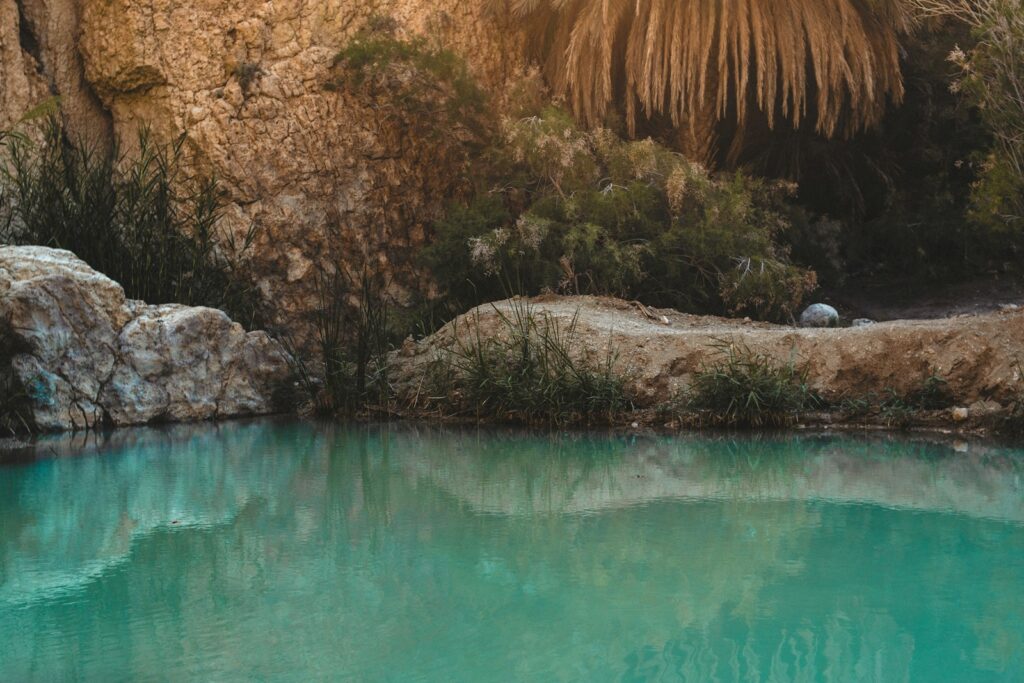
In the path · edge of the Sahara
The oasis at Gafsa
Ancient Capsa — the oasis town that gave its name to the Capsian culture, one of North Africa’s oldest — where the desert gives way to spring-fed pools and palm gardens. It sits squarely inside the path of totality, the gateway to Tunisia’s southern oases: warm rock, water and palms, and almost no other travellers.
Knowing before you go
Getting there & remoteness
Tunis–Carthage is the main international gateway, with direct flights across much of Europe; Enfidha and Djerba also take charter traffic. Sfax, El Jem and Kairouan are an easy drive from Tunis or the Sousse–Monastir coast, while Gafsa and the southern oases are a longer haul inland. Tunisia is less polished than Morocco and genuinely less travelled — that thinner premium infrastructure is exactly the risk, and the differentiation.
Weather in August
Hot and dry. The coast around Sfax sits in the low 30s °C with a sea breeze; the interior and the Sahara are considerably hotter (40 °C and up). There is almost no rain in August and the skies are reliably clear — good odds for the eclipse — but the desert days demand an early-and-late rhythm.
Food
Mediterranean meeting the Maghreb, and spicier than Moroccan food: couscous, brik (a crisp egg pastry), grilled fish on the coast, fiery harissa, superb olives and olive oil (Tunisia is one of the world’s great producers), fresh dates from the southern oases, and mint tea poured over pine nuts.
Religion
Overwhelmingly Sunni Islam, practised moderately — Tunisia is among the more secular-leaning Arab states — with a small, ancient Jewish community centred on Djerba. Friday is the holy day. Visitors are made welcome; modest dress is appreciated, especially at religious sites.
Culture
Berber (Amazigh), Phoenician, Roman, Arab, Ottoman and French layers, all still legible. Expect café culture, malouf music, and living craft — Kairouan’s carpets, Nabeul’s ceramics. Dress and daily life are noticeably relaxed, particularly in Tunis and along the coast.
History
Carthage rose here to rival Rome, and Roman Africa left El Jem and Dougga behind when it won. Then came early Islamic Kairouan, the Ottomans, the French protectorate, independence in 1956 — and, in 2011, the revolution that began the Arab Spring. A lot of history for a small country.
Languages
Arabic (the Tunisian dialect, Derja) is official; French is very widely spoken as a legacy of the protectorate; Amazigh persists in the south; and English is growing in tourism. French will carry you a long way.
Money
The currency is the Tunisian dinar (TND) — a closed currency you can’t buy before you arrive, so withdraw from an ATM on landing (common in cities, scarcer the further south you go). Cards work in hotels and larger places; carry cash for the medinas and the desert. Prices are gentle; bargaining is normal in the souks, and tipping is appreciated.
Safety
Generally safe in the tourist regions — Tunis, the coast, the established Sahara circuits — and the country depends on and polices its tourism. The usual care applies in crowded medinas. Some government advice flags the remote southern border zones (with Libya and Algeria) and certain mountain areas; itineraries stay well clear of these. Solo women may attract some attention; modest dress and confidence help.
Good to know
- Dress — modest in towns and at sites; the Kairouan mosque asks for covered shoulders and knees.
- Alcohol — available in licensed hotels, restaurants and some shops, not everywhere.
- Connectivity — good 4G; a cheap local SIM (Ooredoo, Orange, Tunisie Telecom) keeps you online.
- Health — drink bottled water; no required vaccinations for most; travel insurance is essential.
- Heat — plan the desert around the cool hours; midday in August is fierce.
- Time zone — GMT+1, no daylight saving.
- Respect — ask before photographing people; Friday is the day of rest.
Entry & visas
Refreshingly simple: most Western travellers enter visa-free — no advance visa, no e-visa (Tunisia hasn’t launched one yet), you simply arrive. Your passport needs six months’ validity, and border officers may ask to see a return or onward ticket and proof of accommodation. Rules change, so always confirm on your own government’s page before booking:
| You’re from | Tourist entry | Official source |
|---|---|---|
| United Kingdom | 90 days visa-free | gov.uk travel advice |
| United States | 90 days visa-free | travel.state.gov |
| Canada | Up to 4 months visa-free | travel.gc.ca |
| Australia | 90 days visa-free | smartraveller.gov.au |
| New Zealand | 90 days visa-free | safetravel.govt.nz |
| EU / Schengen | 90 days visa-free | Your national foreign-ministry travel advice |
Canadians are granted up to four months — a quirk of Tunisian rules. Carry proof of onward travel and accommodation. This is a guide, not official advice — verify with the sources above before you book.
The honest trade-off
From the Journal
Victoria as a Solipse gathering place: summer light, coast and reset
Victoria is not the most exotic place Solipse could begin. That is part of its strength.
Tunisia on the path: Sahara, Sfax and a quieter route to totality
Tunisia sits on the 2027 eclipse path with a different kind of promise. It is less obvious than Egypt, less…
Totality: why the sky going dark changes the body’s sense of time
A total solar eclipse is often described as a visual event: the moon passes in front of the sun, daylight…